

Every coupling catalog in the industry markets flexibility, but flexibility is not one property — it is a bundle of behaviors: how much shock the element absorbs, how much misalignment it tolerates, how much torque it packs into its size, and what it costs to keep alive. The industrial grid coupling occupies a specific point in that bundle, and comparing it honestly against elastomeric, gear, and disc couplings is how a plant stops buying couplings by habit and starts buying them by duty. This comparison walks the four coupling families through the same five questions, so the selection that follows is based on measured behavior rather than supplier marketing.
Shock Absorption: Where the Grid Coupling Leads
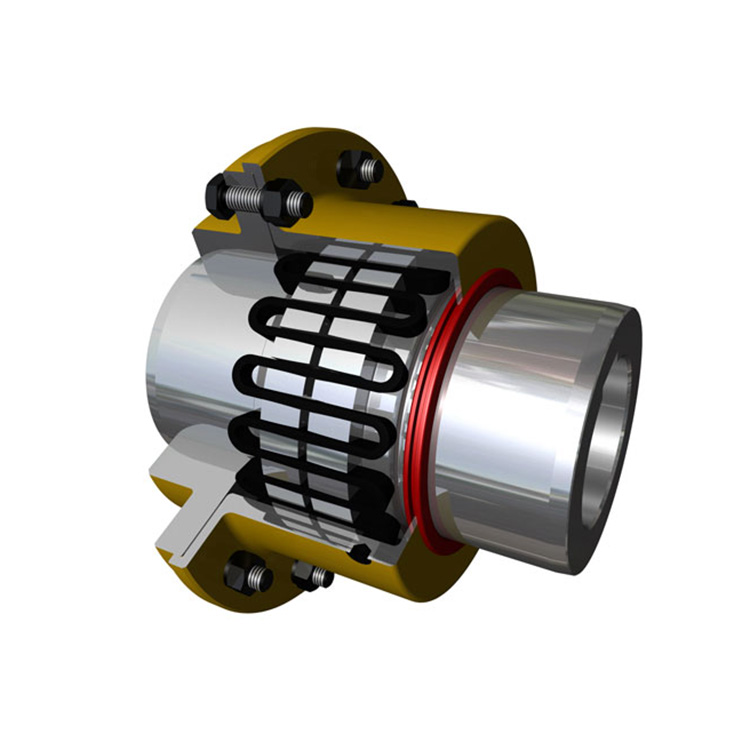
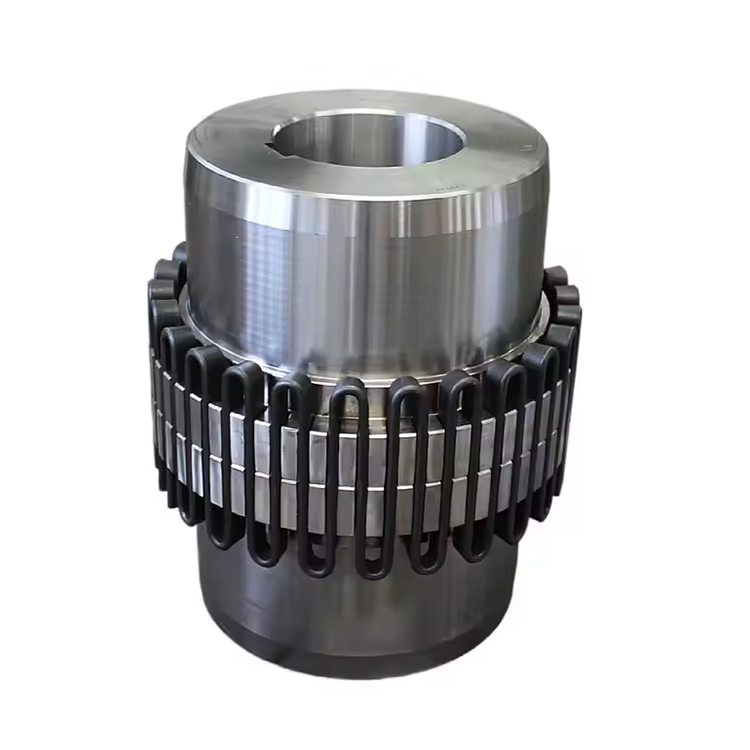
Shock absorption is the grid coupling's home turf. The steel grid spring deflects under torque and returns to shape, absorbing the peak of a jam or a start under load and releasing it gradually into the driven machine. In heavy-shock applications — crushers, mills, reversing conveyors — the grid's 200-300% peak torque capacity cushions events that would spike straight through a rigid element.
Elastomeric couplings absorb shock through rubber or polyurethane in compression or shear, and their limit is temperature: heavy, repeated shock heats the element, and a hot elastomer loses stiffness and grip, turning a shock absorber into a source of slip and failure. Gear couplings transmit shock with almost no absorption — their strength is precision torque transmission, not cushioning. Disc couplings absorb modest shock through metal flexure but are sized for it, meaning the disc pack grows with the shock requirement. For the hardest duty, the industrial grid coupling delivers the absorption without the elastomer's thermal ceiling.
Misalignment Capacity and the Load Penalty
All flexible couplings carry misalignment ratings; the difference is what happens to the coupling while accommodating it. A grid coupling rated for its misalignment tolerance maintains its full torque capacity within that window — the grid flexes, the load spreads, and the coupling keeps working without a derating penalty. That is a distinct advantage in applications where alignment drifts after installation and never returns to laser-perfect.
Disc couplings demand tight alignment because the disc pack's flex life falls sharply as misalignment climbs — a disc coupling at 50% of its angular rating shows a measurable fatigue penalty, and at its full rating the disc pack life drops to a fraction of ideal. Gear couplings tolerate generous misalignment but convert it into sliding tooth motion, which accelerates flank wear and raises the lubrication burden — the more misalignment, the shorter the grease life. Elastomeric couplings carry misalignment easily at low torque but lose capacity as the element stiffens under both load and heat. The practical result: a plant with realistic alignment drift gets more forgiving service from the grid coupling than from families that charge a fatigue or wear penalty for the same offset.
Torque Density and Envelope
Torque density — torque per unit of coupling size and weight — decides how much machine envelope a coupling consumes. Gear couplings lead the field here: case-hardened teeth transmit the highest torque in the smallest package, which is why they dominate high-speed and high-torque applications where envelope is scarce. The industrial grid coupling sits below gear couplings in torque density but above elastomeric designs of equal rating, because the steel grid packs more capacity per inch than rubber in compression.
The envelope question is a machine-design question: a gearbox shaft center fixed by a gear-coupling envelope forces a larger, heavier grid coupling or a disc assembly into the same space. For new machine designs, the envelope is negotiable; for retrofits, it decides. Plants with generous shaft centers — mills, conveyors, mixers — rarely feel the grid coupling's density disadvantage; plants retrofitting a high-speed compressor into an existing skid often cannot use one at all.
Maintenance and Lubrication Demands
The industrial grid coupling is a serviceable, lubricated design: grease at intervals measured in months, internal inspection on a schedule, and a grid element that is cheap, standardized, and replaceable in a couple of hours. Its maintenance story is honest work — the coupling takes care, and it gives warning before it fails. For plants with a maintenance department, that is a feature: the coupling becomes part of the planned-service routine, and the grid replacement is a budgeted consumable.
Disc couplings run dry and maintenance-free between inspections, which makes them attractive where lubrication access is impossible or contamination is a certainty. But that convenience transfers cost: disc packs are more expensive than grids, the coupling must be disassembled to replace them, and the misalignment discipline they demand belongs to the installers. Gear couplings are the most maintenance-sensitive of the four — their tooth wear lives and dies on lubrication discipline, and a missed service on a high-speed unit ends in a coupling failure that takes the machine with it. Elastomeric couplings sit in the middle: no lubrication, but the element is a wear item whose life depends on heat and duty, and its failure mode is often sudden.
Failure Behavior: Warning Versus Surprise
How a coupling fails matters as much as whether it fails. The grid coupling fails progressively: wear appears in the drained grease as metallic particles, the vibration signature climbs gradually, and the grid loses cross-section measurably before fracture. Maintenance crews get months of notice and choose the outage. That predictability is why heavy industry keeps grid couplings on its most critical machines despite cheaper alternatives.
Elastomeric elements fail with less warning — a crack grows invisibly inside the rubber and the element lets go as a sudden loss of drive. Disc couplings telegraph fatigue better through visual inspection but fail suddenly once the first crack propagates. Gear couplings give warning through vibration and temperature if they are monitored, but an unmonitored high-speed gear coupling failure is a major event. For continuous-process plants, the grid coupling's progressive failure is not a nice-to-have; it is the difference between a planned grid swap and a weekend emergency rebuild.
Cost of Ownership Across the Families
Run the five-line ownership cost — purchase, installation, maintenance, component replacement, risk-adjusted downtime — across the families and the picture sharpens. The industrial grid coupling wins on heavy shock duty where its absorption protects the gearbox and its replaceable grid keeps component cost low. Gear couplings win where envelope and high-speed precision dominate and the plant's lubrication discipline is strong. Disc couplings win in clean, well-aligned, low-misalignment service where their zero-maintenance element offsets the higher replacement cost. Elastomeric couplings win on light uniform duty where the element outlives the service interval and simplicity is the whole game.
The decision rule that survives contact with reality: pick the coupling family by the worst condition the machine will actually see, not the average. A conveyor that jams weekly is a grid coupling machine; a clean fan that runs at constant speed is an elastomer machine; a precision spindle is a disc machine; a high-speed compressor is a gear machine. The families are not rivals in a beauty contest — each is the right answer to a specific duty profile, and the plants that match them correctly are the ones without the coupling wall of shame.
Frequently Asked Questions
Is a grid coupling a flexible coupling?
Yes. The grid spring is the flexible element, and the industrial grid coupling is one of the older and most proven flexible coupling families. The difference between it and other flexible types is the element material and its behavior — steel spring flexibility instead of elastomer deflection or metal disc flexure.
When does a gear coupling beat a grid coupling?
When torque density and speed are the binding constraints — high-speed, high-torque service where envelope is scarce, and where the plant has the lubrication discipline to keep the teeth alive. Gear couplings transmit more torque per size than grids but pay for it with strict maintenance and sudden failure potential.
Can I replace a grid coupling with an elastomeric coupling?
Only if the duty fits. Elastomeric couplings handle uniform and light-shock loads well, but heavy shock heats and degrades the element, and their failure mode is more sudden. On a shock-loaded mill or conveyor, downgrading from a grid coupling to an elastomer is a common cause of unexpected downtime.
Why do disc couplings need such tight alignment?
Because the disc pack's fatigue life is sensitive to misalignment. Every degree of angularity above the rated value shortens the pack's life disproportionately. Disc couplings reward the plants that align them precisely and punish the ones that do not — the opposite of the grid coupling's tolerance for real-world drift.
Conclusion
The industrial grid coupling and its flexible coupling cousins are not interchangeable commodities; they are distinct engineering answers to distinct duty profiles. The grid coupling brings steel-spring shock absorption, full torque capacity within its misalignment window, a serviceable cheap-to-replace element, and progressive failure that gives a plant warning. Gear, disc, and elastomeric couplings each beat it in their own territory — torque density, zero maintenance, and cost on light duty respectively. The plants that match coupling family to actual worst-case duty are the ones whose couplings fade quietly into the maintenance routine; the ones that buy by habit keep a wall of failed elements as evidence. Matching the type to the duty is the whole selection.
References
AGMA 9002-B04 — Flexible Couplings: Design Considerations and Selection
ISO 14691:2008 — Flexible Couplings: Design, Selection and Application
Mancuso, J.R. (1999). Couplings and Joints: Design, Selection, and Application, 2nd Edition. Marcel Dekker.
Bloch, H.P. & Geitner, F.K. (2011). Machinery Failure Analysis and Troubleshooting, 4th Edition. Butterworth-Heinemann.
Nelson, F.C. (2015). "Vibration Isolation and Damping in Rotating Machinery." Shock and Vibration Handbook, 6th Edition. McGraw-Hill.