

Speed is one of the most consequential operating variables in coupling selection. A coupling that performs reliably at 1,800 RPM may fail catastrophically at 3,600 RPM, not because its design is flawed but because speed changes the mechanical environment fundamentally. Centrifugal forces increase with the square of speed, lubrication dynamics shift, balance sensitivity rises, and vibration modes change. Engineers who understand these speed-dependent behaviors can specify couplings that deliver reliable performance throughout the operating speed range rather than only under idealized laboratory conditions.
This article examines how key coupling performance parameters vary with rotational speed, providing the analytical foundation for selecting the right coupling type and specification for high-speed, variable-speed, and variable-torque industrial applications.
Centrifugal Force Effects on Coupling Components
Centrifugal force acting on coupling components scales with the square of rotational speed. Doubling the speed quadruples the centrifugal force, fundamentally altering how the coupling operates. At low speeds, the effects are negligible; at high speeds, they dominate coupling behavior and become the primary constraints on speed rating.
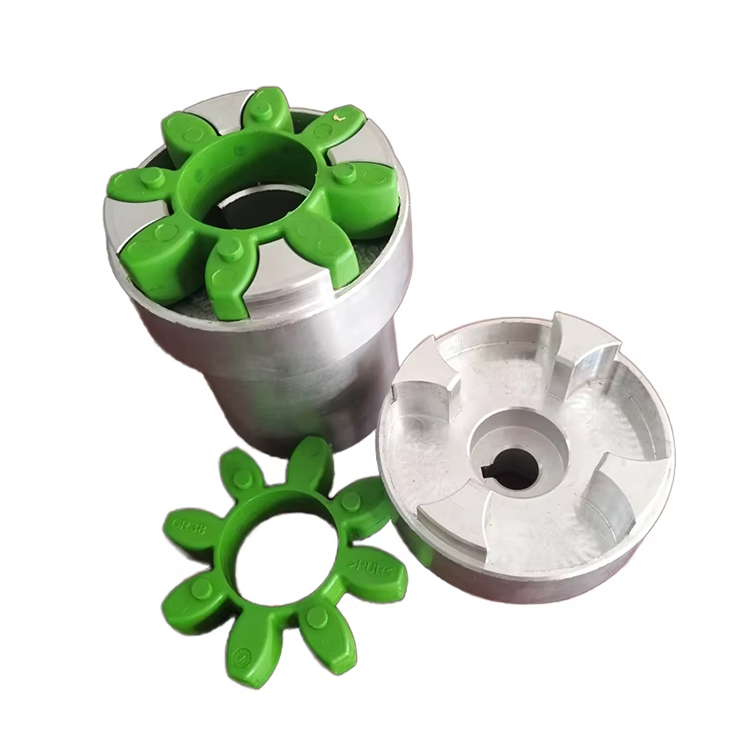
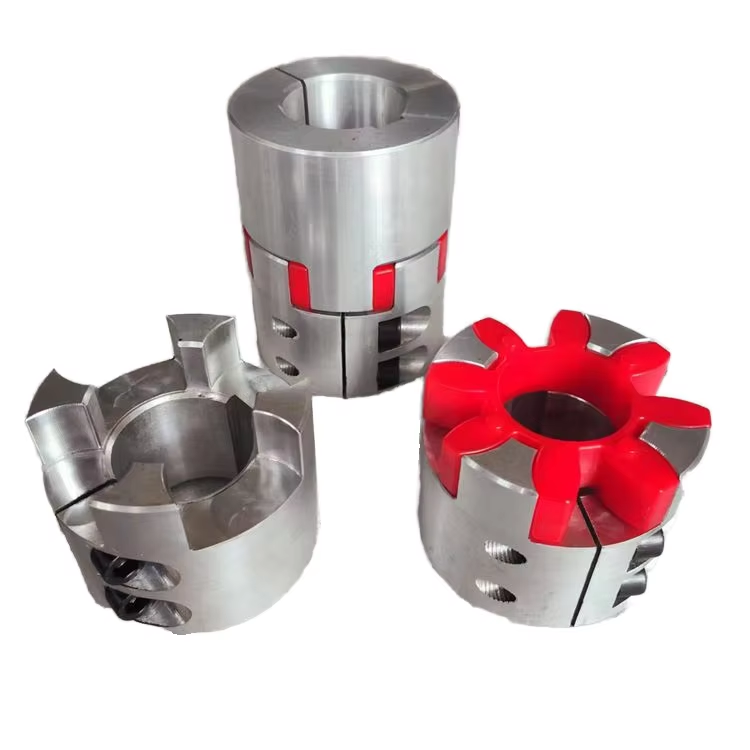
For a flexible coupling with an internal flexible element — whether grid, elastomer, or disc pack — centrifugal force tends to displace the flexible element outward, reducing contact pressure at the tooth or interface surface. In a grid coupling, this displacement reduces the interference between the grid spring and hub teeth, potentially allowing the grid to shift position during operation. In an elastomeric coupling, centrifugal expansion of the element reduces its effective deflection capability and changes the coupling's torsional stiffness.
The speed at which centrifugal effects become significant depends on the coupling size and design. For typical industrial couplings in the 4-10 inch diameter range, meaningful centrifugal influence appears above 2,500-3,000 RPM. Above this threshold, coupling manufacturers specify speed derating factors that reduce the published torque and misalignment ratings proportionally to the actual operating speed.
Speed Effects on Coupling Torque Transmission
Torque transmission capacity does not remain constant as speed changes. The coupling's ability to transmit torque is influenced by the dynamic forces that either assist or resist torque transfer, depending on the coupling type and operating speed.
In gear-type couplings, the tooth contact forces include both the mechanical interference from interference fit and the centrifugal contribution that pushes hub and sleeve components outward against their retaining hardware. At very high speeds, this centrifugal contribution can exceed the interference fit forces, fundamentally changing how the teeth engage. When centrifugal force dominates the tooth loading, the effective torque capacity increases slightly — but the risk of tooth surface distress from inadequate lubrication also increases because the centrifugal force competes with the lubrication film for contact area.
Elastomeric couplings experience stiffness changes with speed that affect torque transmission indirectly. At higher speeds, the elastomer's dynamic modulus increases, raising the effective torsional stiffness and reducing the coupling's compliance. This speed-dependent stiffening narrows the vibration isolation bandwidth, potentially reducing the coupling's effectiveness at attenuating torsional vibration in variable-speed applications. Engineers specifying elastomeric couplings for variable-speed drives must account for this stiffening behavior across the entire intended speed range.
Balance Sensitivity and Critical Speed Considerations
Unbalance in a coupling generates vibration forces proportional to the unbalance magnitude and the square of rotational speed. At low speeds, these forces are negligible; at high speeds, they can dominate the vibration spectrum and cause equipment damage even with what would be considered acceptable unbalance at lower speeds.
The critical speed of the coupled shaft system — the rotational speed at which the natural frequency of the shaft-coupling system coincides with the excitation frequency from unbalance — becomes increasingly important as operating speeds rise. A coupling with significant axial or torsional compliance can shift the shaft system's effective natural frequency, either moving it away from operating speeds (beneficial) or closer to operating speeds (harmful). Torsional analysis during coupling selection for high-speed applications identifies whether the coupling's compliance characteristics help or hurt critical speed separation.
Standard industrial coupling balance specifications typically follow ISO 21940 G6.3 quality grade, adequate for speeds up to approximately 3,600 RPM on most shaft diameters. Applications with sustained operation above 4,000 RPM require higher balance grades — G2.5 or G1.0 — achieved through precision machining, material removal at identified heavy spots, or addition of balance correction weights. The additional cost of precision balancing is justified by the proportional reduction in vibration forces at high speed.
Lubrication Dynamics at Elevated Speeds
Lubrication requirements for coupling components change significantly with increasing speed. The lubrication film that separates contacting surfaces — grid teeth in gear couplings, disc pack interfaces in disc couplings — must be thick enough to prevent metal-to-metal contact while remaining stable under the combined effects of load, temperature, and centrifugal forces.
Grease lubrication in high-speed coupling applications faces a fundamental challenge: centrifugal force expels grease from the tooth contact zone, leaving surfaces inadequately lubricated during sustained high-speed operation. High-speed coupling designs address this through reduced grease fill quantities — typically 30-50% of standard fill — which leaves adequate void space for grease redistribution while maintaining sufficient lubrication at the contact surfaces. Overfilling a high-speed coupling with grease causes excessive churning, overheating, and accelerated seal failure.
Lubricant viscosity selection also shifts with speed. High-speed applications favor lower-viscosity lubricants that reduce fluid friction and churning losses. However, lower viscosity reduces the lubrication film thickness at the contact surfaces, potentially increasing wear under high load conditions. The balance between churning losses and film thickness requires careful consideration for coupling applications that operate continuously at high speeds.
Variable Speed Operation Challenges
Variable speed drives present unique coupling behavior challenges because the coupling must perform effectively across a wide speed range rather than at a single design point. The coupling's characteristics at minimum speed may be entirely different from its behavior at maximum speed, and transitions between speeds introduce dynamic effects not present in constant-speed operation.
During speed transients — acceleration and deceleration through the operating range — the coupling experiences temporary conditions that differ from either the low-speed or high-speed steady-state behavior. Elastomeric couplings may undergo substantial stiffness changes during rapid speed changes, while gear couplings experience transient shifts in tooth loading distribution as centrifugal forces build or decay. These transient effects are particularly significant in cycling applications where the drive repeatedly accelerates and decelerates through a wide speed range.
Selecting a coupling for variable speed service requires defining the critical speed points — minimum operating speed, maximum operating speed, and any speed ranges where sustained operation occurs. The coupling's behavior at each of these points should be evaluated separately, with the selection based on the most demanding condition rather than an average across the speed range.
Temperature Rise at High Speeds
Heat generation in a coupling increases with speed from multiple sources: friction at sliding contacts, grease churning, and windage losses from the coupling rotating through still air. At low speeds, these heat sources are negligible; at high speeds, they can raise the coupling temperature substantially above ambient, affecting lubricant viscosity, seal material properties, and the dimensional stability of the coupling components.
Thermal expansion of the coupling components from heat generation changes the fit conditions between hub and shaft and within the coupling's internal clearances. A coupling that fits properly at operating temperature may have excessive clearance when cold or inadequate clearance when hot, depending on the balance of thermal expansion between components. High-speed applications require thermal analysis to verify that the coupling maintains adequate clearance margins across the full temperature range from cold startup to sustained high-speed operation.
Thermal equilibrium — the balance between heat generation and heat dissipation — determines the steady-state operating temperature of the coupling. Couplings operating continuously at high speed typically reach equilibrium temperatures 40-80°F above ambient, depending on the cooling conditions. Couplings with limited cooling — enclosed designs, couplings in insulated enclosures — may reach equilibrium temperatures that approach or exceed the lubricant or seal material temperature limits.
Frequently Asked Questions
How does speed affect coupling torque capacity?
Speed affects torque capacity indirectly through centrifugal effects on component loading and lubrication film stability. Standard torque ratings assume operation below the speed threshold where centrifugal forces significantly alter tooth engagement or flexible element positioning. Operating above this threshold requires applying manufacturer-provided speed derating factors or selecting a coupling designed specifically for the higher speed range.
What balance grade does a high-speed coupling application need?
For continuous operation at 3,600 RPM, ISO 21940 G6.3 balance grade is standard. Above 3,600 RPM, G2.5 is typically required. Applications approaching 5,000-6,000 RPM may require G1.0 or tighter. The specific requirement depends on shaft diameter, coupling mass, and the vibration sensitivity of connected equipment.
Can the same coupling work at both low and high speeds?
A single coupling can operate across a speed range if its speed rating encompasses both the minimum and maximum operating speeds and the coupling's performance characteristics remain acceptable throughout the range. However, the coupling's behavior at the extremes of the speed range may differ substantially, and both extremes should be evaluated independently during selection.
What causes a coupling to overheat at high speed?
Overheating at high speed typically results from excessive grease fill causing churning losses, inadequate cooling from the installation environment, seal friction from contact seals, or sustained operation beyond the coupling's speed rating. Identifying the heat source through temperature measurement and operating condition correlation enables corrective action before thermal damage occurs.
Conclusion
Coupling behavior changes fundamentally with speed across torque transmission, centrifugal loading, balance sensitivity, lubrication dynamics, variable-speed characteristics, and thermal performance. Engineers who account for these speed-dependent behaviors during coupling selection achieve reliable performance throughout the operating speed range, while those who select couplings based on room-temperature, low-speed specifications alone risk premature failures from speed-related mechanisms. Understanding how speed influences each aspect of coupling performance is essential for reliable industrial power transmission across the full range of modern drive applications.
References
AGMA 9002-B04 — Flexible Couplings: Design Considerations and Selection
ISO 14691:2008 — Flexible Couplings: Design, Selection and Application
ISO 21940-11:2016 — Mechanical Vibration: Rotor Balancing
API 671 — Special Purpose Couplings for Petroleum, Chemical, and Gas Industry Services
Mancuso, J.R. (1999). Couplings and Joints: Design, Selection, and Application, 2nd Edition. Marcel Dekker.