

Equipment lifetime in industrial power transmission is determined by the cumulative effect of mechanical stresses applied across every operating cycle. An industrial grid coupling directly influences this lifetime by controlling the magnitude and distribution of stresses that reach bearings, shafts, seals, and driven equipment. Facilities using properly selected grid couplings consistently report 30-50% longer service intervals for connected equipment compared to rigid or underspecified flexible coupling installations — a difference that translates directly to reduced maintenance costs and higher production availability.
This article examines the engineering mechanisms through which the industrial grid coupling extends equipment lifetime, supported by field data and established mechanical principles applicable across mining, processing, and heavy manufacturing operations.
Shock Load Attenuation: Protecting Drivetrain Components
The most direct way an industrial grid coupling improves equipment lifetime is through shock load attenuation. When a crusher encounters an uncrushable object or a conveyor experiences a jam, the resulting torque spike can reach 3-5 times normal operating torque within milliseconds. Without the grid coupling's progressive flexing mechanism, this shock propagates directly through the drivetrain, overloading gear teeth, stressing shaft keyways, and damaging motor windings.
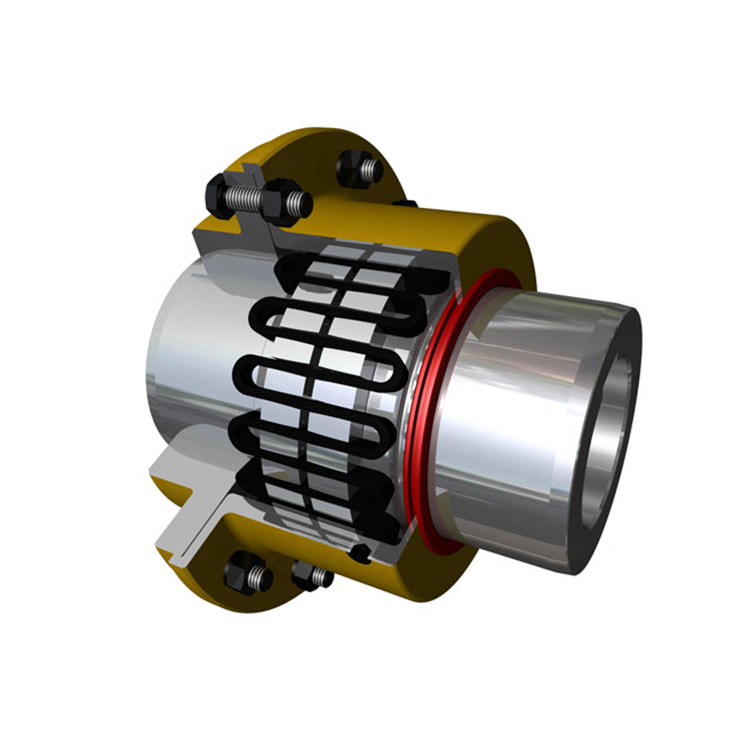
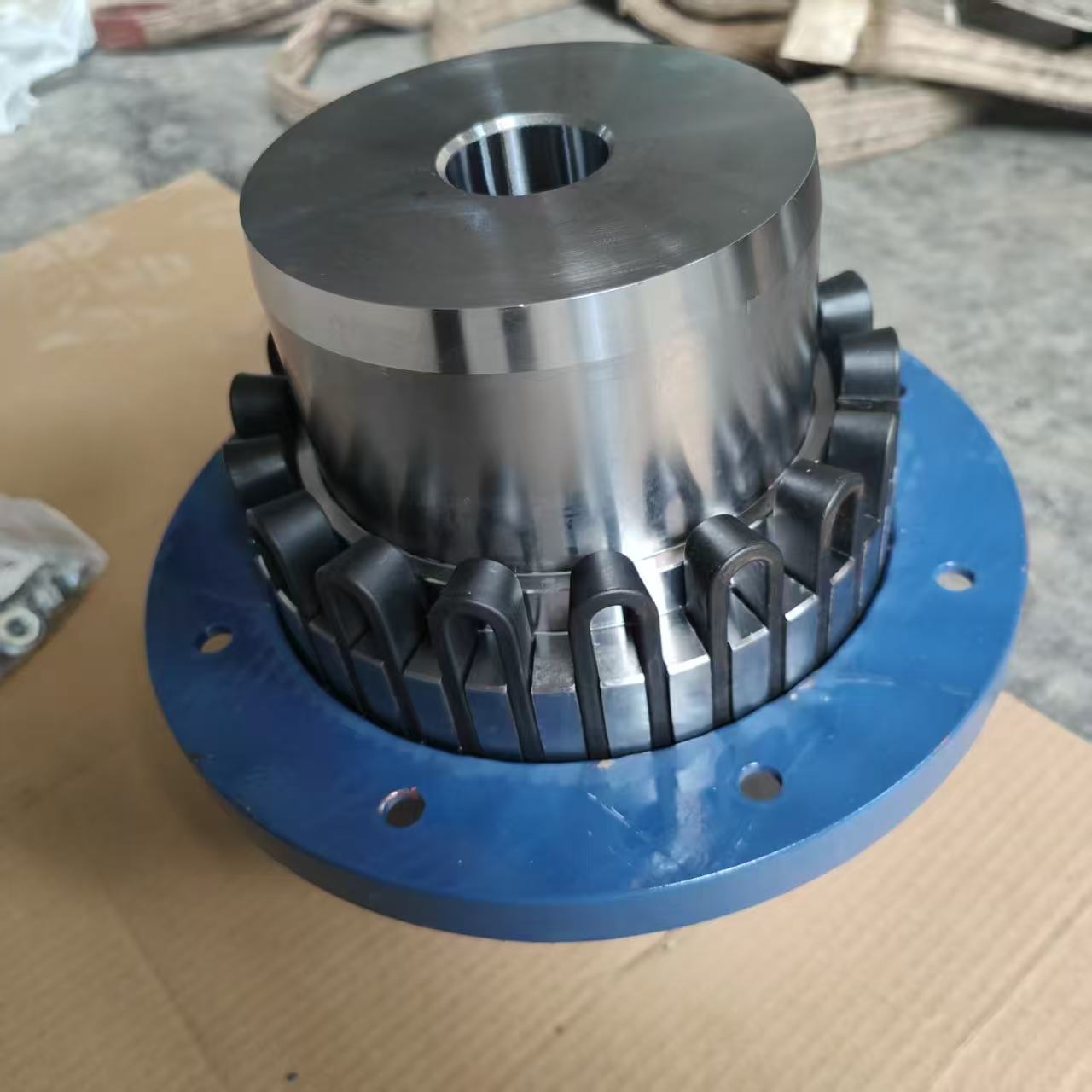
The grid spring's serpentine geometry provides progressive engagement — as torque increases, additional grid segments contact additional hub tooth surfaces, distributing the peak load across a wider area. This progressive engagement converts a sharp, high-magnitude shock into a broader, lower-magnitude pulse. Field measurements show that grid couplings reduce peak transmitted torque during shock events by 40-60% compared to rigid connections, with the attenuation effectiveness increasing with shock severity.
Each shock event prevented from reaching downstream components represents extended life for those components. A gearbox experiencing 50% fewer shock events above its design threshold effectively doubles its service life against shock-related failure modes — tooth fracture, bearing race cracking, and shaft keyway deformation. The industrial grid coupling provides this protection continuously across every operating cycle without requiring maintenance between scheduled inspections.
Vibration Damping and Fatigue Life Extension
Fatigue failure — progressive damage accumulation under cyclic loading — is the dominant failure mechanism in most rotating equipment components. Vibration increases the amplitude of cyclic loading, accelerating fatigue damage accumulation. The industrial grid coupling reduces transmitted vibration through friction damping at the grid-tooth interface, where relative motion between the grid and hub teeth dissipates vibrational energy as heat rather than transmitting it to downstream components.
The vibration damping provided by grid couplings is particularly effective at the 2X and 3X frequency harmonics that are characteristic of misalignment-induced vibration. These harmonics — often the most damaging to bearings and seals — experience 50-70% amplitude reduction when transmitted through a properly lubricated grid coupling. The damping effect is continuous across the operating speed range, providing protection at every running speed rather than only at specific resonant conditions.
The fatigue life extension resulting from vibration damping follows established S-N curve relationships — a 30% reduction in cyclic stress amplitude can increase fatigue life by a factor of 3-5 for steel components operating in the finite-life regime. This means that the vibration damping provided by a grid coupling can extend the life of downstream shafts and components from months to years in vibration-intensive applications.
Misalignment Protection: Preventing Bearing Overload
Shaft misalignment is a leading cause of premature bearing failure in industrial equipment. Each degree of angular misalignment generates cyclic radial loads on bearings that can reduce L10 bearing life by 60-80% compared to properly aligned installations. The industrial grid coupling accommodates misalignment within its flexing element, preventing the transmission of misalignment-induced forces to the bearings.
The grid coupling's misalignment accommodation is achieved through controlled flexing of the grid spring within the hub tooth profile. This flexing provides angular misalignment capacity of 0.5-1.0° per flex plane and parallel offset capacity of 0.010-0.060 inches depending on coupling size. The grid accommodates these displacements without transmitting significant reaction forces to the connected shafts, effectively isolating the bearings from misalignment-related loading.
Field data from mining operations shows that bearing replacement intervals increase by 40-60% when flexible grid couplings are installed between motors and driven equipment, compared to rigid couplings that transmit all misalignment forces to the bearings. The savings in bearing replacement costs alone often justifies the coupling investment within the first year of operation, with additional benefits from reduced downtime and maintenance labor.
Torsional Compliance and Transient Stress Reduction
Torsional compliance — the coupling's ability to twist under applied torque — provides a cushioning effect that reduces stress during torque transients. When a motor starts, the initial torque surge can reach 150-200% of full-load torque. Without compliant coupling, this surge transmits directly to the driven equipment, stressing gears, belts, and connections. With a grid coupling, the grid spring deflects under the surge, storing energy and releasing it gradually as the driven equipment accelerates.
The torsional stiffness of an industrial grid coupling is nonlinear — it increases as torque increases and the grid engages more fully within the hub teeth. This nonlinear stiffness provides high compliance at low torque (during startup and light-load operation) and progressively stiffens as torque approaches rated capacity (during normal operation). The result is effective transient attenuation during abnormal conditions without excessive wind-up under normal loads.
Torsional vibration — cyclic torque fluctuations at frequencies related to the drivetrain's natural characteristics — is attenuated by the grid coupling's friction damping. This damping is particularly beneficial in applications with reciprocating drivers or driven equipment, where torsional vibration is a persistent operating characteristic rather than a transient event. Reducing torsional vibration amplitude by 30-50% through proper coupling selection can extend gearbox service life by 2-3 times in these applications.
Corrosion Resistance in Demanding Environments
Equipment lifetime in corrosive environments is limited by the rate of material degradation from chemical attack and oxidation. The industrial grid coupling extends equipment life in these environments through its material selection flexibility — grid springs are available in stainless steel grades that resist corrosion while maintaining mechanical properties. Standard stainless grid materials — 17-7PH, 17-4PH, and AISI 301 — provide corrosion resistance 5-10 times greater than carbon steel grids in equivalent service.
For the most demanding environments — offshore platforms, chemical processing plants, and coastal installations — grid couplings with specialized coatings and seal materials provide additional protection. The coupling seals prevent corrosive agents from reaching the hub tooth surfaces and grid spring, while the sealed grease fill provides a protective barrier against moisture and chemical ingress. This combined protection extends coupling life in corrosive environments by 2-3 times compared to unsealed coupling designs.
The coupling's sealed housing also protects the connected shaft ends from corrosion by preventing moisture and chemicals from accessing the shaft surface beneath the coupling hub. In environments where shaft corrosion is a recurring problem, the grid coupling's sealing function provides secondary equipment lifetime benefits beyond coupling protection alone.
Contamination Exclusion Through Sealed Design
Contamination — abrasive particles, moisture, and chemical agents — accelerates wear in every mechanical component. The industrial grid coupling's sealed housing excludes contaminants from the critical grid-tooth interface, maintaining lubrication quality and preventing abrasive wear that would otherwise shorten coupling life. Steel mill, mining, and cement plant applications where dust and grit are pervasive demonstrate the protective value of sealed coupling designs.
The sealing effectiveness directly affects coupling service life. Laboratory testing comparing sealed versus unsealed grid couplings in dust-laden environments shows 3-5 times longer service life for sealed designs. The seals prevent abrasive particles from entering the tooth mesh where they would accelerate grid and tooth wear, and they prevent moisture ingress that would promote corrosion.
Contamination exclusion benefits extend beyond the coupling to connected equipment. A grid coupling that fails from contamination-induced wear produces debris that can enter the lubricant system of the connected gearbox or bearing housing. Preventing coupling failure through effective sealing prevents this secondary contamination pathway, protecting downstream equipment from a failure mode that originates in the coupling but propagates through the entire drivetrain.
Frequently Asked Questions
How much does an industrial grid coupling reduce bearing loads?
Field measurements show that properly specified grid couplings reduce the cyclic bearing loads from misalignment by 60-80% compared to rigid couplings. This reduction extends bearing L10 life by a factor of 2-3 in typical industrial installations. The actual reduction depends on the amount of misalignment present and the coupling's position within its rated misalignment capacity.
Can a grid coupling extend the life of existing equipment?
Yes. Retrofitting an existing installation with a properly selected grid coupling can reduce the mechanical stresses that are progressively damaging the equipment. Facilities that convert from rigid to flexible grid couplings typically see measurable reductions in maintenance frequency for bearings, seals, and shafts within 6-12 months of conversion, even when the existing equipment has been in service for years.
How often should the grid be replaced to maintain equipment protection?
Grid replacement intervals depend on operating severity, but most industrial applications achieve 2-4 years of grid life before cross-section reduction reaches the 15% replacement threshold. Replacing grids on a preventive schedule — rather than waiting for failure — ensures continuous equipment protection. Facilities that replace grids at 3-year intervals typically report 80-90% fewer coupling-related equipment failures.
Does a grid coupling protect equipment during starting and stopping?
Yes, the grid coupling's torsional compliance is most active during starting and stopping when torque transients are largest. The grid flexes under startup torque surges, reducing the peak torque transmitted to downstream equipment by 30-50%. This protection is particularly valuable for equipment with high inertia that experiences extended starting periods and correspondingly prolonged torque transients.
Conclusion
The industrial grid coupling improves equipment lifetime through multiple complementary mechanisms: shock load attenuation protects against catastrophic overload events, vibration damping extends fatigue life under cyclic loading, misalignment accommodation prevents bearing overload, torsional compliance cushions torque transients, and sealed construction excludes contamination. Each mechanism addresses a specific source of equipment degradation, and together they provide comprehensive protection that extends the service life of connected drives, gearboxes, bearings, and driven equipment. Facilities that invest in properly specified grid couplings consistently achieve measurably lower maintenance costs and higher production availability — a direct result of the coupling's contribution to extended equipment lifetime.
References
AGMA 9002-B04 — Flexible Couplings: Design Considerations and Selection
ISO 14691:2008 — Flexible Couplings: Design, Selection and Application
Brasel, J.N. (2010). "Failure Analysis of Grid Couplings in Heavy-Duty Applications." Journal of Mechanical Design, 132(8), 081001.
API 671 — Special Purpose Couplings for Petroleum, Chemical, and Gas Industry Services
Harris, T.A. & Kotzalas, M.N. (2007). Rolling Bearing Analysis, 5th Edition. CRC Press.