

An industrial coupling rarely operates in the clean, controlled environment implied by specification sheets developed in climate-controlled test laboratories. In reality, couplings face temperature extremes, moisture, abrasive dust, chemical exposure, outdoor weather, and Ultraviolet rays radiation from sunlight — environmental stresses that degrade materials, compromise lubrication, and accelerate wear mechanisms that reduce service life far below catalog predictions. Understanding these environmental factors and their effects enables engineers to specify couplings that survive and perform reliably in the conditions they actually encounter.
This article analyzes the primary environmental stressors affecting coupling performance, explains the degradation mechanisms involved, and provides guidance for selecting and specifying couplings appropriate for demanding industrial environments.
Temperature Extremes and Thermal Degradation
Temperature is the environmental factor with the broadest impact on coupling performance. Both high and low temperature extremes stress coupling components through different mechanisms, and the rate of temperature change — thermal cycling — adds a third degradation pathway that is often more damaging than sustained temperature exposure.
At high temperatures, lubricant viscosity decreases, reducing the lubrication film thickness at tooth contacts and flexing interfaces. Elastomeric elements experience accelerated aging as the rubber crosslinks more rapidly, increasing stiffness and reducing flexibility until the element cracks. Seal materials soften and lose their ability to maintain the sealing lip geometry that prevents lubricant escape and contaminant entry. Standard coupling designs rated for continuous operation to 250°F may fail within months at sustained temperatures of 350°F due to these combined effects.
Low temperatures create different problems. Lubricant viscosity increases dramatically, potentially preventing adequate flow to tooth contacts during startup. Elastomeric elements stiffen and lose compliance, reducing misalignment accommodation and shock absorption. Seal materials become brittle and may crack, losing their sealing effectiveness. Cold weather also promotes moisture condensation within the coupling housing, introducing water that accelerates corrosion of grid springs and hub tooth surfaces.
Moisture and Humidity Effects on Coupling Components
Moisture in all its forms — humidity, condensation, direct water exposure, and salt spray — attacks coupling components through corrosion, lubrication contamination, and material degradation. The effects range from cosmetic surface oxidation that has minimal performance impact to accelerated fatigue failures from corrosion pits that act as crack initiation sites.
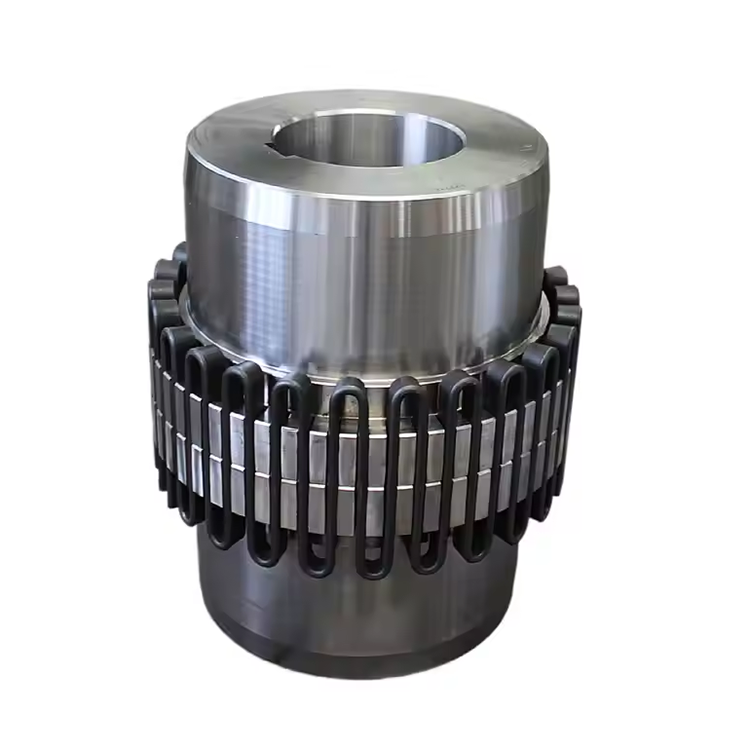
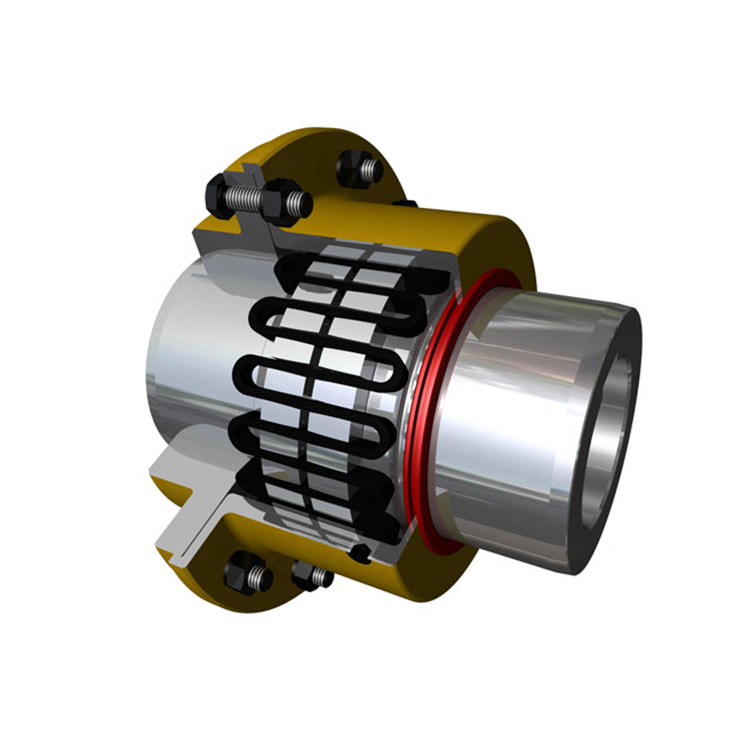
Carbon steel grid springs are particularly vulnerable to moisture-induced corrosion. A grid spring with surface corrosion pits has reduced effective cross-sectional area at the pit locations, concentrating stress and accelerating fatigue crack propagation. Under severe conditions — marine environments, outdoor installations in humid climates — untreated carbon steel grids may require replacement intervals measured in months rather than years.
Stainless steel grid options provide 5-10 times the corrosion resistance of carbon steel in equivalent service, but they are not immune to moisture effects. Certain stainless grades — particularly the austenitic 300 series — are susceptible to stress corrosion cracking in environments with both high stress and specific chemical agents. For the most demanding moist environments, precipitation-hardened stainless grades such as 17-4PH provide superior corrosion resistance combined with higher strength.
Abrasive Dust and Particulate Contamination
Mining, quarrying, cement, and aggregate processing expose coupling components to high concentrations of fine abrasive particles — silica dust, rock fines, and metallic particles from nearby operations. These particles infiltrate coupling seals, contaminate lubricant, and become embedded in elastomeric elements, acting as an abrasive third body that accelerates wear at every flexing interface.
The contamination mechanism is straightforward: particles enter through seal gaps, mix with lubricant, and are carried into the tooth contact zone where they embed in soft metal surfaces or sit between hard surfaces, creating three-body abrasion that dramatically accelerates wear rates. A coupling operating in a dusty environment may show wear rates 3-5 times higher than an identical coupling in clean conditions, even when the dust appears to be excluded by the coupling's seals.
Heavy-duty sealed designs with labyrinth seals, enhanced sealing lips, and purged housings provide improved protection against abrasive contamination. Some manufacturers offer coupling covers with positive pressure purging — connecting a low-pressure air or grease supply to the cover cavity to maintain outward flow that prevents particle ingress. For the most severe dust environments, coupling manufacturers can provide specialized contamination-exclusion packages that extend service life substantially beyond standard sealed designs.
Chemical Exposure and Aggressive Media
Chemical processing, petrochemical, and offshore applications expose coupling components to aggressive media — acids, alkalis, solvents, and hydrocarbons — that attack materials through direct chemical reaction or solvent action. The coupling components most vulnerable to chemical attack are the seals, lubricant, and any elastomeric elements; the metallic components are generally more resistant but can still suffer from certain chemical agents.
Elastomeric coupling elements are particularly vulnerable to chemical attack because the rubber compounds used in standard designs are formulated for general industrial service rather than chemical resistance. A standard nitrile rubber element swells, softens, or hardens when exposed to incompatible fluids, losing the flexibility needed for misalignment accommodation and shock absorption. Chemical-resistant elastomer options — Viton, EPDM, neoprene, and specialty compounds — provide resistance to specific chemical families but at higher cost and sometimes reduced mechanical performance in non-chemical dimensions.
Lubricant compatibility with the chemical environment must also be considered. Standard petroleum-based greases may be dissolved or washed away by hydrocarbon contact, while water-based fluids may cause rust on unprotected steel surfaces. The coupling lubricant specification must account for potential chemical exposure, selecting products that maintain film strength and corrosion protection in the specific environment.
UV Exposure and Outdoor Weathering
Outdoor installations expose coupling components to ultraviolet radiation, precipitation, temperature cycling, and ozone — environmental factors that attack elastomeric elements, seal materials, and protective coatings through photochemical degradation, oxidation, and thermal fatigue.
Ultraviolet radiation breaks down the polymer chains in rubber compounds through a process called UV photodegradation. The surface of unprotected elastomeric elements becomes chalky, cracked, and brittle within months of outdoor exposure, reducing flexibility and creating crack initiation sites. UV-stabilized elastomer compounds incorporate UV absorbers and antioxidants that slow this degradation substantially, extending outdoor service life from months to years.
Thermal cycling from outdoor temperature swings — daily heating and cooling cycles that cause expansion and contraction — creates fatigue stresses in seals, cover materials, and bolt fasteners. These thermal fatigue cracks often initiate at stress concentrations around bolt holes, seal lips, and cover edges, providing pathways for moisture and contaminant entry. Outdoor coupling installations benefit from thermal insulation covers that reduce the amplitude of thermal cycling by shielding the coupling from direct solar heating.
Altitude and Atmospheric Pressure Effects
High-altitude installations — mountain facilities, mining operations at elevation, aircraft ground support equipment — present coupling challenges related to reduced atmospheric pressure. At altitude, the reduced air density decreases convective cooling, raises the operating temperature of enclosed equipment, and changes the behavior of润滑ants that depend on air saturation for proper function.
The reduction in convective cooling becomes significant above approximately 3,000 feet elevation. Enclosed couplings at 10,000 feet elevation may run 15-25°F hotter than identical installations at sea level, due to the reduced ability of the thinner air to carry heat away from the coupling housing. This temperature increase accelerates lubricant degradation, seal aging, and any temperature-sensitive performance characteristics.
Some seal designs that rely on atmospheric pressure differential for their sealing function perform differently at altitude. Lip seals that create a sealing contact pressure through spring force rather than pressure differential maintain their function at altitude, while designs that depend on pressure differential may exhibit increased leakage rates as the external atmospheric pressure decreases.
Frequently Asked Questions
How does high temperature reduce coupling service life?
High temperature accelerates lubricant degradation, ages elastomeric elements, weakens seal materials, and induces thermal fatigue in metallic components. Each degree above the coupling's rated temperature approximately doubles the rate of thermal aging reactions. A coupling rated for 250°F service may lose 50% of its expected service life for every 25°F above rated temperature.
What coupling materials resist corrosion in marine environments?
Stainless steel grid springs — particularly 17-4PH and 301 grades — provide the best corrosion resistance for marine environments. Epoxy or polyurethane cover coatings protect ferrous covers from salt spray corrosion. Seals must be specified for salt-water resistance, typically using Viton or specialized marine elastomers. Regular inspection and lubrication intervals should be shortened for marine installations.
Can a standard coupling work in a dusty mining environment?
Standard couplings operate in dusty environments but show dramatically shortened service life. For mining applications, specify heavy-duty sealed designs with enhanced labyrinth seals, consider purged cover options, and use shortened lubrication intervals. Despite these modifications, expect service life shorter than clean-environment installations due to the severity of dust infiltration.
How do I select a coupling for chemical processing applications?
Identify every chemical agent that may contact the coupling during normal operation, cleaning, or maintenance. Select elastomer compounds compatible with each identified chemical. Verify lubricant compatibility with the same agents. Consider stainless steel or coated metallic components for strongly corrosive chemicals. Consult coupling manufacturer chemical resistance charts and request material samples for compatibility testing when exposure conditions are severe or uncertain.
Conclusion
Environmental factors — temperature extremes, moisture, abrasive dust, chemical exposure, UV radiation, and altitude — each attack coupling components through specific degradation mechanisms that reduce service life below catalog predictions. Specifying couplings that survive and perform reliably in real industrial environments requires understanding these mechanisms, selecting appropriate materials and sealing configurations, and adjusting maintenance intervals to account for the accelerated wear conditions. The additional cost of environmental protection options — stainless grids, chemical-resistant elastomers, enhanced seals, and thermal insulation — is justified by the dramatic service life extension they provide compared to standard catalog specifications applied without environmental consideration.
References
AGMA 9002-B04 — Flexible Couplings: Design Considerations and Selection
ISO 14691:2008 — Flexible Couplings: Design, Selection and Application
API 671 — Special Purpose Couplings for Petroleum, Chemical, and Gas Industry Services
Shigley, J.E. et al. (2020). Shigley's Mechanical Engineering Design, 12th Edition. McGraw-Hill.
Mancuso, J.R. (1999). Couplings and Joints: Design, Selection, and Application, 2nd Edition. Marcel Dekker.