

Most grid coupling failures are not surprises. They are the visible end of a degradation that passed unnoticed through skipped inspections, missed grease changes, and a replacement grid that never made it onto the planned-outage schedule. A maintenance checklist is only useful if it is built around what actually fails on a coupling — not a generic form copied from a manual. The points below come from what field crews find when a grid coupling comes apart, written so a technician can run the list without guessing.
Whether the unit came from a long-term grid coupling supplier or a one-off purchase, the inspection logic is the same: catch the wear before it becomes a stoppage.
Pre-Start Check Before Returning to Service
After any coupling work, confirm the cover bolts are at the specified torque with a calibrated wrench, not by feel. Loose cover bolts let the housing separate, which breaks the seal and starts grease loss within the first shift. Then rotate the shaft by hand through a full turn — a properly assembled grid coupling turns smoothly with only the slight resistance of the grid flexing; binding or a hard spot means the grid seated wrong or a segment is bent.
Check the grease fitting and level plug are present and sealed. A missing plug is an open invitation for contaminant entry the moment the belt, crusher, or mill starts moving material past the coupling.
External Visual Inspection
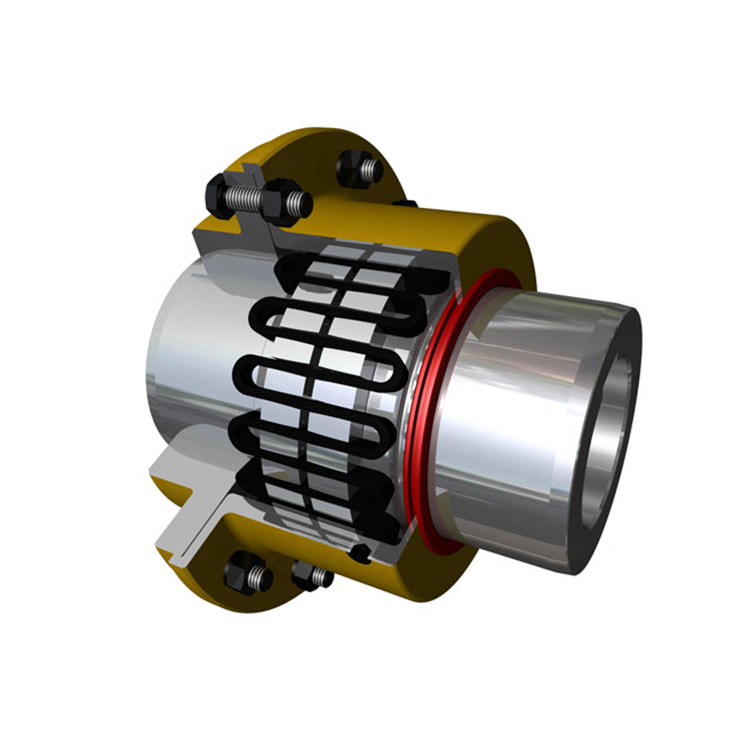
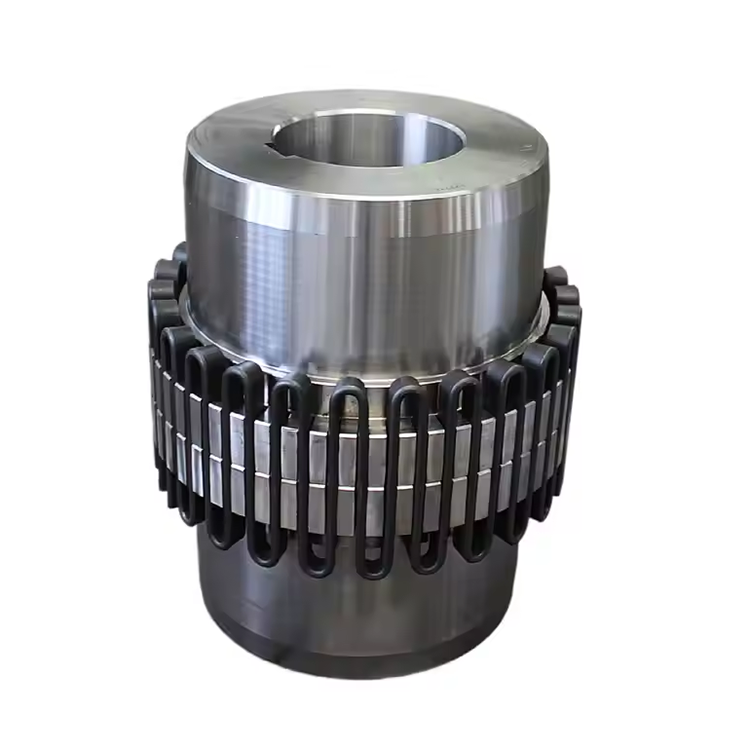
Walk the unit monthly. Look at the cover for cracks, dents, and corrosion that compromise the sealed space around the grid and teeth. Any cover damage lets lubricant escape and grit in, and both accelerate the internal wear that ends the coupling.
Watch the seal lips for grease weeping. A little seepage right after lubrication is normal; active leakage between services means the seal has let go. On the opposite sign, rust at the seal line means contaminant is getting in. Either condition earns the seal a replacement at the next window — delaying it turns a cheap seal swap into a full coupling overhaul once the grid and teeth are damaged.
Confirm cover bolts have not backed off from vibration. Any that have loosened get re-torqued and marked; repeated loosening on the same bolts points to a thread or cover problem worth a deeper look.
Quarterly Internal Inspection
The internal check is where the real condition shows. Pull the cover, remove the grid, and measure its cross-section at several points with calipers. Compare to the original dimension — a grid past roughly 15% cross-section loss gets changed, regardless of running hours. Grids between 10% and 15% stay in service but get watched more closely.
Read the discharged grease like a diagnostic sample. Gritty texture means metallic wear particles from the grid or teeth. Darkening beyond normal indicates heat. Separation of oil from thickener means the grease broke down and is no longer protecting the surfaces. Any of these changes the lubrication plan immediately rather than at the next scheduled date.
Inspect the hub tooth flanks. Uniform wear across all teeth is normal lubricated service. Wear concentrated on a few teeth signals misalignment loading those contacts. Pitting means lubrication broke down or contaminant entered. Score marks along the tooth face mean abrasive grit is in the grease and must be flushed before a new grid goes in, or the replacement wears the same way.
Lubrication Service and Grease Management
Lubrication is the single biggest lever on grid coupling life. Use the specified semi-fluid grease with the right EP additives; substituting a general-purpose product looks fine for a week and fails the tooth film within a season. Fill to the level plug, never past it — overfill just pressurizes the cover and pushes grease past the seals.
Compatibility matters when changing grease types. Mixed, incompatible greases can react and lose their lubricating character. If switching products, purge the old grease from the housing first. Store open drums sealed in a cool, dry spot and rotate stock so old grease is not applied to new couplings.
Vibration Monitoring and Trending
Healthy couplings run below about 0.1 inch per second velocity at the coupling location. Set a baseline right after installation and trend each reading against it. A gradual climb means progressive wear or alignment drift; a sudden step means a discrete event — a shock load or an impact — that may have damaged the grid.
Frequency tells the story. 1X vibration suggests misalignment or imbalance; 2X points specifically at angular misalignment; higher harmonics suggest looseness in the coupling or its hardware. Permanently mounted sensors on critical grid coupling installations turn this from periodic snapshots into continuous alarm coverage.
Alignment Verification
Re-laser the coupling after the first thermal cycle, with the equipment at running temperature, not cold. Equipment moves between cold and hot, and the alignment taken cold is rarely the alignment the coupling sees at load. If hot readings exceed about 75% of the coupling's rated misalignment, adjust before the next run.
Target the as-left alignment at roughly half the rated misalignment in both planes. That margin absorbs the drift from thermal growth and load variation, so the grid coupling is never running at its limit while transmitting torque.
Replacement Decision Criteria
Change the grid when cross-section loss passes 15%, when visible cracks appear at the segment transitions, or when corrosion pitting reduces effective area. For critical drives, many plants replace grids on a fixed calendar — treating the grid as a consumable — because the cost of an unplanned stoppage dwarfs the grid price.
Replace the whole coupling when hub tooth profiles show pitting, scoring, or wear that prevents proper grid engagement. Hubs last several grid cycles in well-kept units, so hub replacement is a less frequent but more consequential event that should be planned well ahead, particularly for custom bore sizes with long lead times.
Frequently Asked Questions
How often should a grid coupling be inspected internally?
Heavy-duty units — crushers, mills, reversing drives — every two to three months. Medium-duty, three to six. Light-duty, six to twelve. Adjust from what the inspections actually show: if wear stays low, extend; if it climbs, shorten. The calendar follows the condition, not the other way.
What does gritty discharged grease mean?
Abrasive particles in the lubricant, almost always from a seal breach letting dust or grit into the housing. It lapps the grid and teeth. Change the grease, fix the seal, and inspect the grid for accelerated wear before the unit goes back to full duty.
Can I reuse a grid after pulling it for inspection?
If cross-section is above 85% of original, no cracks, no heavy corrosion, and no permanent set, yes. Many reliability programs replace it anyway during any disassembly, treating the grid as cheap insurance against an uncertain reused element.
Why trend vibration instead of watching absolute limits?
A single reading out of context says little; the trend shows direction. A coupling climbing steadily toward alarm flags developing wear weeks before failure, letting the change happen on a planned outage instead of during production.
Conclusion
A grid coupling maintenance checklist earns its place only when it tracks what fails — grid wear, seal breach, misalignment, lubrication breakdown, and the vibration that announces all three. Run as a condition-based routine rather than a dated form, the checklist extends coupling life, protects the connected bearings and gearboxes, and converts coupling care from reactive emergency repair into planned, low-cost service. The discipline costs a fraction of the downtime it prevents.
References
AGMA 9002-B04 — Flexible Couplings: Design Considerations and Selection
ISO 14691:2008 — Flexible Couplings: Design, Selection and Application
ISO 17359:2018 — Condition Monitoring and Diagnostics of Machines: General Guidelines
Brasel, J.N. (2010). "Failure Analysis of Grid Couplings in Heavy-Duty Applications." Journal of Mechanical Design, 132(8), 081001.
API 671 — Special Purpose Couplings for Petroleum, Chemical, and Gas Industry Services