

Vibration and noise in rotating machinery are more than quality-of-life concerns for workers near operating equipment. They are engineering symptoms — measurable indicators of energy being transferred inefficiently through the drivetrain, loading bearings and seals with cyclic forces that accelerate wear, damage components, and generate the maintenance costs that erode facility profitability. The spring grid coupling addresses vibration and noise at their source, absorbing and dissipating vibrational energy before it propagates through the drivetrain to damage the equipment it was meant to protect.
This article explains the mechanisms through which spring grid coupling technology reduces vibration and noise, translating mechanical engineering principles into practical understanding that supports better coupling selection decisions for industrial facilities seeking to improve equipment reliability and reduce operational noise levels.
The Vibration Transmission Problem in Industrial Drivetrains
Every rotating drivetrain generates vibration. Motor torque pulsations, imperfect balance, gear mesh frequencies, bearing defects, and shaft runout all produce cyclic forces that translate into vibration at frequencies spanning from fractions of Hertz to thousands of Hertz. In a rigidly connected drivetrain, these vibrations propagate unimpeded from their source to every connected component — motors, gearboxes, pumps, compressors, and structural supports — each receiving the full vibratory load regardless of whether it generated the vibration.
The vibration energy that propagates through rigid connections does mechanical work on every component it passes through. Bearings experience oscillating load components that reduce their effective life by concentrating fatigue damage at specific race locations. Seals undergo repetitive deflection that accelerates lip wear and lubricant leakage. Shaft keyways experience alternating shear stresses that initiate fatigue cracking. The equipment fails not from a single overload event but from the accumulated damage of millions of vibration cycles.
The solution is not to eliminate vibration — the sources are inherent to rotating machinery — but to interrupt its transmission through the drivetrain. The spring grid coupling accomplishes this interruption through its flexible element, which decouples the vibration source from the downstream equipment while continuing to transmit the steady-state torque that the drive needs to perform its function.
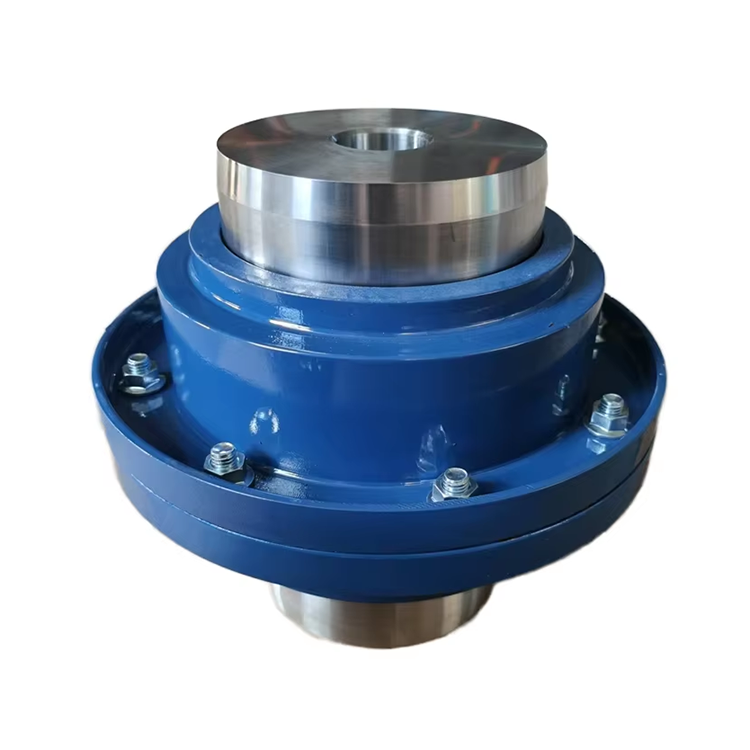
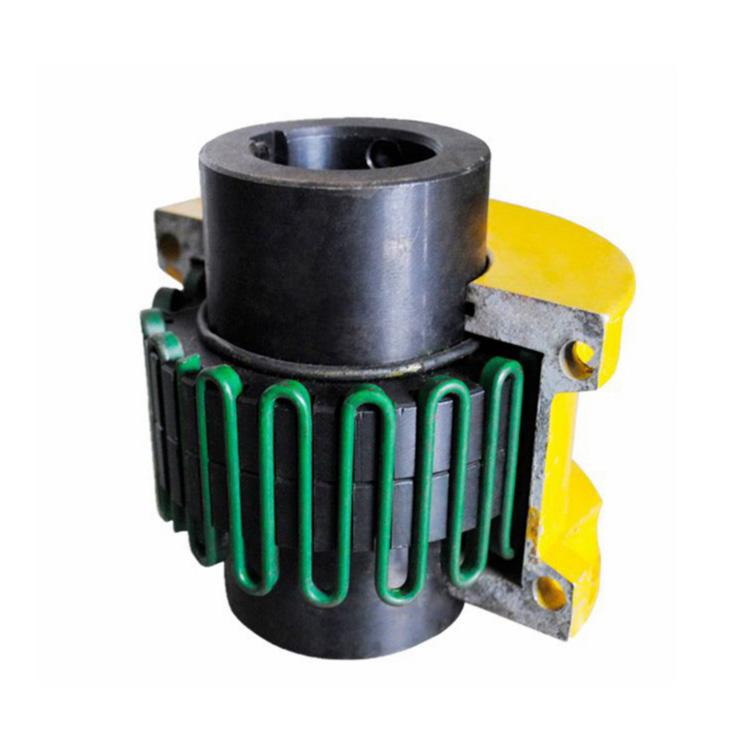
Torsional Damping: The Primary Vibration Reduction Mechanism
The spring grid coupling reduces vibration primarily through torsional damping — the dissipation of vibrational energy as heat at the interface between the grid spring and the hub tooth surfaces. As the coupling transmits torque, microscopic relative motion between the grid and the hub teeth creates friction that converts torsional vibration energy into heat rather than transmitting it through the drivetrain.
This damping mechanism operates most effectively at the torsional vibration frequencies typical of motor-driven equipment — typically 10-100 Hz for electric motor drives. At these frequencies, the spring grid coupling acts as a tuned vibration absorber, dissipating energy selectively at the frequencies where most industrial vibration problems occur. The damping is self-regulating: higher vibration amplitude produces more relative motion at the grid-tooth interface, increasing friction and energy dissipation proportionally.
Field measurements demonstrate that properly selected spring grid coupling installations reduce torsional vibration amplitude at the driven equipment by 40-60% compared to rigid connections in identical service. This reduction directly extends bearing and seal life because the cyclic load components that cause fatigue and wear are reduced by the same proportion. In vibrating equipment, even a 25% reduction in vibration amplitude can double or triple bearing service intervals.
Misalignment Accommodation and Resulting Vibration Reduction
Misalignment between driver and driven shafts generates vibration at frequencies determined by the shaft speed and the misalignment magnitude. Angular misalignment produces 1X and 2X frequency components, while parallel offset produces 1X vibration with a characteristic phase relationship. A spring grid coupling that accommodates misalignment within its flexible element prevents these misalignment-induced forces from generating vibration in the first place.
The mechanism is straightforward: in a rigidly connected drivetrain, misalignment forces the shafts to bend slightly to accommodate the offset between their centerlines. This bending produces cyclic stress that generates vibration in the shaft, bearings, and motor frame. The spring grid coupling absorbs the misalignment within its flexing grid element, relieving the connected shafts of the bending stress that would otherwise produce vibration.
The vibration reduction from misalignment accommodation can be substantial. Industrial equipment with shaft misalignment of 0.005 inches or more typically shows 1X vibration amplitudes of 0.1-0.3 inches per second at the bearing housings. Installing a spring grid coupling that accommodates this misalignment can reduce these amplitudes by 50-70% within days of installation, with corresponding improvements in bearing condition and operating noise levels.
Noise Reduction Through Vibration Isolation
Noise and vibration are closely related — noise is vibration transmitted through air rather than through solid structures. The spring grid coupling reduces noise indirectly by reducing the vibration that generates it. Equipment that vibrates less produces less airborne noise, particularly at the frequencies where structural resonance amplifies both vibration and sound.
The noise reduction mechanism involves structural coupling between the motor, coupling, and driven equipment. Rigid connections transmit vibrational energy efficiently through the structural path, exciting resonant frequencies in the equipment housings, bases, and surrounding structures that radiate sound. The spring grid coupling introduces compliance at the connection point that disrupts this structural energy transmission, reducing the excitation of resonant structures and consequently reducing radiated noise.
Facilities that measure both vibration and noise before and after spring grid coupling installation consistently report correlated reductions in both measurements. A typical result is 3-8 dB reduction in sound pressure level at the equipment surface, corresponding to a 50-70% reduction in perceived loudness. For facilities with occupational noise exposure concerns, this level of reduction may move the equipment from hearing protection required areas to areas where protection is not mandated.
Critical Speed Management Through Coupling Compliance
The torsional compliance of a spring grid coupling influences the natural frequencies of the coupled drivetrain system. Natural frequencies are the frequencies at which the system resonates — responding to even small inputs with large amplitude vibrations when the excitation frequency coincides with a natural frequency. Managing these natural frequencies away from operating speeds prevents resonance conditions that would otherwise amplify vibration and noise dramatically.
The spring grid coupling adds torsional compliance to the drivetrain that lowers the effective torsional natural frequency of the system. For drivetrains where the natural frequency lies dangerously close to operating speeds, this reduction moves the natural frequency further away, increasing the separation margin that prevents resonance. Engineers performing torsional analysis during coupling selection can exploit this effect by selecting coupling stiffness that achieves the desired natural frequency separation.
Variable-speed drives particularly benefit from spring grid coupling compliance because they pass through a wide speed range during startup and operation. If the drivetrain natural frequency falls within the operating speed range, the drive will experience amplified vibration at the resonance speed during every startup. A coupling with appropriate torsional stiffness shifts this resonance outside the operating range, eliminating the vibration event that would otherwise occur each time the drive accelerates through the critical speed.
Installation Practices That Preserve Vibration Reduction Performance
The vibration and noise reduction capabilities of a spring grid coupling are fully realized only when the coupling is installed correctly. Improper installation can substantially reduce or entirely eliminate the benefits that proper coupling selection promised.
Alignment quality directly affects the coupling's contribution to vibration reduction. The coupling accommodates misalignment within its design limits, but operating near the limits forces the grid to flex more aggressively, generating friction and heat at the tooth interface that can actually produce vibration rather than reduce it. Maintaining alignment at 50-60% of the coupling's rated misalignment capacity ensures the grid operates in its optimal flexing range for maximum vibration attenuation.
Lubrication condition affects damping performance. The spring grid coupling achieves its damping through friction at the grid-tooth interface, but this friction must occur across a properly lubricated surface to avoid metal-to-metal wear. Adequate lubricant film at the contact surfaces enables friction damping without wear, while inadequate lubrication allows adhesive wear that generates debris and degrades damping performance over time.
Frequently Asked Questions
How much vibration reduction can a spring grid coupling provide?
Field measurements show 40-60% reduction in torsional vibration amplitude and 30-50% reduction in radial vibration at bearing housings when comparing spring grid coupling installations to rigid connections in equivalent applications. The actual reduction depends on the alignment quality, coupling size relative to the application, and the specific vibration frequencies present.
Does a spring grid coupling eliminate all vibration?
No coupling eliminates vibration entirely. The spring grid coupling reduces vibration transmitted through the coupling by absorbing and dissipating vibrational energy, but it does not affect vibration generated within the connected equipment itself. Vibration from bearing defects, rotor imbalance, or mechanical looseness within the driven equipment continues regardless of the coupling specification.
Can the wrong coupling increase vibration?
Yes. A spring grid coupling with insufficient misalignment capacity — operating continuously near its rated limits — generates additional vibration from excessive grid flexing and friction. A coupling with inappropriate torsional stiffness can also shift the system natural frequency into the operating speed range, creating resonance that amplifies vibration rather than reducing it. Proper coupling selection requires engineering analysis of both the application requirements and the coupling's torsional characteristics.
How does lubrication affect spring grid coupling vibration damping?
Proper lubrication maintains the friction damping mechanism at the grid-tooth interface without causing metal-to-metal wear. The damping requires controlled friction — too little lubrication increases wear and generates noise, while too much lubrication floods the interface and reduces the friction that enables damping. Maintaining the manufacturer's specified fill level and using the correct lubricant type preserves the damping performance throughout the coupling's service life.
Conclusion
The spring grid coupling reduces vibration and noise through torsional damping that converts vibrational energy to heat, misalignment accommodation that prevents misalignment-generated vibration, structural isolation that reduces airborne noise radiation, and torsional compliance that manages critical speeds away from operating ranges. These mechanisms work together to extend bearing and seal life, reduce occupational noise exposure, and improve the overall reliability of industrial drivetrains. Facilities that specify properly selected and correctly installed spring grid couplings consistently measure the vibration and noise reductions that validate the coupling's contribution to equipment reliability and operational environment quality.
References
AGMA 9002-B04 — Flexible Couplings: Design Considerations and Selection
ISO 14691:2008 — Flexible Couplings: Design, Selection and Application
Nelson, F.C. (2015). "Vibration Isolation and Damping in Rotating Machinery." Shock and Vibration Handbook, 6th Edition. McGraw-Hill.
API 671 — Special Purpose Couplings for Petroleum, Chemical, and Gas Industry Services
Mancuso, J.R. (1999). Couplings and Joints: Design, Selection, and Application, 2nd Edition. Marcel Dekker.